
Energy Efficient Eco Friendly Green Water Heater
Posted by Norman F

Looking for a new water heater?
AO Smith makes the Vertex 100 water heater that is very efficient at 96% thermal efficiency. The 50-gallon Vertex delivers hot water output that exceeds a 75-gallon atmospheric gas water heater. The Vertex can deliver continuous hot water flow of over 4 gallons per minute. It has a LCD display allowing precise temperature control. The Vertex 100 has a dedicated loop for radiant hot water heating systems. Dimensions are similar to a standard 50-gallon power-vent water heater. 100,000 BTU input per hour. Jay Leno and Ed Begly Jr have these units.
Vertex 100 does requires PVC, CPVC or ABS pipe venting not traditional metal venting. It also requires a separate intake PVC airline. The unit requires AC power to run its fan. This fan makes this unit’s operation a bit noisy. It is probably best suited for a garage. Vertex 100 water heaters cost roughly $2000+ installed minus the Federal and any local utility rebate. Our local utility PG&E has a $50 rebate.
How does it compare to a ‘normal‘ energy saving water heater? AO Smith’s Conservationist series 50 Gallon model has an Energy Factor of 0.62. and 40,000 BTU input per hour. Approximately 80% efficient. It costs about $1300.
An entry level model, ProMax 50 Gallon Water Heater costs about $600 and has an Energy Factor of 0.58. Approximately <80% efficient.
It it worth spending $800 more for the Vertex 100? Will you recoup the price difference over the unit’s six year lifespan?
Clearly without the rebate, the price difference is a huge. A rough estimate of saving $10 a month in gas x 6 year lifespan = $720. If it lasts longer than six years, then you are in the right zone. If you need to install a new PVC exhaust an intake pipe, there goes the savings. Consumer Reports states “..high cost offsets much of the roughly $70 per year the Vertex will save you.”
We recently installed The Vertex 100 water heater and so far so good.
Alternatives to the Vertex
Phoenix Evolution is a 96% efficient, 135,000 BTU water heater that can provide hot water for the domestic system, radiant heating, hydro air and even solar assist all in one appliance that qualifies for the Federal rebate. 55-119 Gallons. It also needs PVC Venting. The catch, the Phoenix costs several thousand dollars.
Heat pump water heaters
Heat pump water heaters are another way of keeping your energy bill down. General Electric Co. and Rheem Manufacturing Co. make these heaters, which suck up heat from the air in a basement or garage to assist heating water for the home. It’s like a refrigerator working in reverse. According to Rheem officials, this machine has an operating cost of $225 and $280 per year or about half of a common electric water heater. These heaters are not cheap, costing nearly $1500 for a 50 gallon model, three times more than a normal electric water heater, and five times more than a natural gas powered one. Payback time could be three to four years.
Solar Water Heater

Solar Water Heating is using the sun to heat water, thereby saving on you money on your gas bill by eliminating or reducing the amount of water that needs to be heated. It is cheaper to install than solar electricity and has a faster payback.
You need to do your homework first. Find out how solar friendly your home’s location is, how much hot water you use, upfront costs, cost of fuel, tax incentives, and rebates. Systems range in price from $7,000 – $10,000. They should drop your water heating bills by 50 – 80%. Water heating typically uses 15-25% of the energy consumed by a home. Federal Tax Credit is currently 30%. Typical return on investment is 3 to 10 years. Those that live in cold winter climates may have longer payback times.
Energy.gov has information of estimating a solar water heating system’s cost and payback.
The economics are even better if you are refinancing or building a new home. You could roll the cost into your mortgage and write off the mortgage interest.
Hot Water Recirculating Pumps
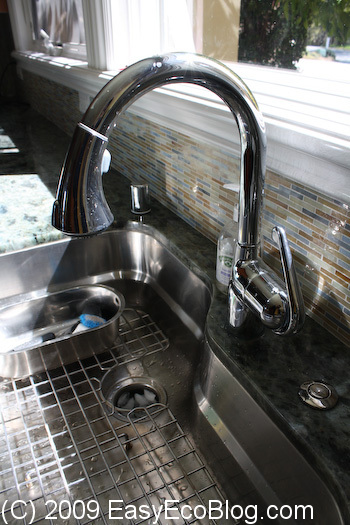
How much water do we waste waiting for hot water? We have seen figures estimating 10 gallons of water are wasted a day, waiting for the shower, tap, dishwasher etc. This cost money and is a total waste.
To get instant hot water you need to have a loop in the piping system that circulates hot water back to the water heater. Recirculating pump systems employs a temperature actuated by-pass valve that connects the cold and hot water supply lines at the fixture that is farthest away from the water heater. The system is designed to provide hot water at the most distant fixture and every fixture in series, or close to the main water line. The bypass valve uses the cold water line as the return loop back to the water heater.
Most pumps use electricity and have timers to set operation. Handy folks can install hot water recirculating pump systems themselves. Note that hard water causes problems for these systems.
Also be sure to put insulation on your hot water pipes.
Hybrid Water Heaters – GE GeoSpring Water Heater

We recently covered Tankless Water Heaters. A new product is the Hybrid Water Heater. Like ones from Eternal and GE. Hybrids have 2 modes of operation. With low flows it has a fixed gas input rate from the preheated water, with higher water needs, it uses a flow sensor like a tankless water heater. GE claims their electric, Energy Star Qualified Geospring Water Heater uses up to 62% less energy than a conventional water heater, and saves $300 a year in energy costs. It has a high energy factor of 2.35. Consumerreports.org has a mini review, their October 2010 print issue has a bigger review.
Hybrid Water Heaters are much higher in efficiency than a regular water heaters, but holds less hot water, usually less than 50 gallons. Recall that Tankless water heaters may not have the capacity to satisfy multiple water uses at the same time and have issues when temperatures are cold. Energy Star standards are emerging for these new items. These units can be up to 50% more efficient.
Downsides:
- They are taller, up to 7 feet tall
- Hybrid water heaters need space to capture uncooled air, upto 1000 sq ft
- If you do no have a nearby drain, a condensate pump ($150) is needed
- They are noisier than conventional water heaters
These items are not cheap, they start around $1600 – $2000 for a 50 gallon, 15GPM GE GeoSpring Hybrid Water Heater model. It is projected to have a 56% annual savings, resulting in a short 4.5 year payback time with Federal Tax Credit. 10 year warranty.
The 50 gallon Rheem HP50RH hybrid water heater is slightly cheaper at $1600 – $1750, 58% annual savings, 4 year payback, 10 year warranty.
Most Hybrid Water heaters are covered by local utility rebates, so you can save additional money by purchasing it.
Tankless Water Heater

A Tankless Water heater produces hot water as hot water is requested. Traditional water heaters have large tanks to store and heat water, so they continually have to keep the water heated.
A Tankless Water heater uses electricity or gas to quickly heat water that is needed. Different units are capable of product hot water at different rates. Gas units generally perform better. Large units or multiple units are required if you need to have say a kitchen sink, shower, and other things operating at the same time. Savings up to 30% can be realized.
everun even makes a stylish tankless water heater that you need not hide. They cost from $200 to $1200.
Some key items to look for are electrical or gas needs of the unit, and venting requirements. Many gas units require a certain size of gas inlet and exhaust vent size. I found these requirement prohibitive in my installation attempt. Electric tankless do not require expensive vent piping.
Climate is also a factor. Those living in very cold areas with water barely above freezing in the winter should think twice before going tankless.
Federal tax credits for energy efficiency are available to help reduce the cost. Many local gas utilities also have rebates.
Reduce Water Heater Energy Use with your present water heater.
Filed under: Conservation, Eco Friendly, Effort, Energy, Green, Home, Medium, Money, Reduce, Shopping, Water | Tags: AO Smith, Phoenix Evolution, Vertex 100, water heater
If you enjoyed this post, be sure to subscribe to our RSS feed.
2 Responses to “Energy Efficient Eco Friendly Green Water Heater”
Leave a Reply
Please do not put your URL in the comment text and please use your PERSONAL name or initials and not your business name.



August 4th, 2010 at 9:40 am
[…] Be sure to also consider a Hybrid Water Heater or an Energy Efficient water heater. […]
August 10th, 2010 at 12:02 am
[…] you could replace your water heater with a modern more efficient unit. Natural Gas models have up to 0.67 Energy Factor (EF) ratings now. Modern […]